
Table of Contents
Quick answer
First-time chicken owners who struggle usually do so not from lack of love for their birds, but from lack of a daily routine — without a consistent morning and evening schedule, feeding, water checks, egg collection, and coop security slip, and problems compound quickly. Building a simple 10-minute morning and 5-minute evening routine from day one prevents 80% of the issues new keepers face in their first six months.
Becoming a first time chicken owner is equal parts exciting and intimidating. You fall in love with the peeping chicks while quietly wondering if you actually have everything you need. Most of the stress does not come from the chickens themselves, but from the setup and not knowing where to start.
When I first started keeping chickens, I quite literally bought 6 chicks from Tractor Supply, along with a bag of wood shavings, a heating lamp, and a bag of chick feed. Basically I pieced everything together as I went and learned a lot of lessons the hard way. I then bought a cheap coop, used whatever feeders and waterers I had on hand, and kept making upgrades as problems popped up. Each season brought a new problem, and a new fix. Some worked, some definitely did not.
I lost chickens, cried more than once, and seriously questioned my life choices as a chicken keeper. If you are reading this before making the same mistakes, consider this your warning: the problem was not bad luck or inexperience, it was a setup that was never designed to work together. I fell victim to buying cheap things with little research, only to inevitably spend more on quick upgrades instead of starting with a complete system that actually supported my flock.
My experience is why I encourage new chicken keepers to think about chicken keeping as a whole. When the core components are planned to work together from the start, daily care feels far more manageable and much less overwhelming, especially in the first year.
Why the First Year Feels Hard for a First-Time Chicken Owner
The first year of chicken keeping is when habits, routines, and expectations are formed. For a first time chicken owner, this is also when uncertainty is at its highest.
Most challenges fall into a few categories:
Learning daily care routines
Managing waste and odor
Protecting chickens from predators
Adapting to weather changes
Realizing something important was overlooked
Let's be clear: These challenges aren’t a sign you’re doing something wrong. They’re a sign that chicken keeping works best when it’s planned as a whole.
Instead of asking “What coop should I buy?” the better question for a first time chicken owner is “What does my setup need to handle over the next year?”
Think in Terms of a System, Not Individual Pieces
A system-based approach means your coop, run, airflow, and cleaning plan are designed to support each other.
For a first time chicken owner, this matters because it:
Reduces guesswork
Prevents rushed upgrades
Makes daily care easier
Builds confidence faster
When everything works together, you spend less time fixing problems and more time enjoying your flock.
The 5 Core Components of a First-Year Chicken System
Chicken keeping works best when the most important pieces are planned together. Instead of thinking about one item at a time, it helps to look at the setup as a complete system that supports how chickens live day to day.
For a first time chicken owner, that system comes down to five core components. When these pieces work together, daily care feels easier, more predictable, and far less overwhelming.
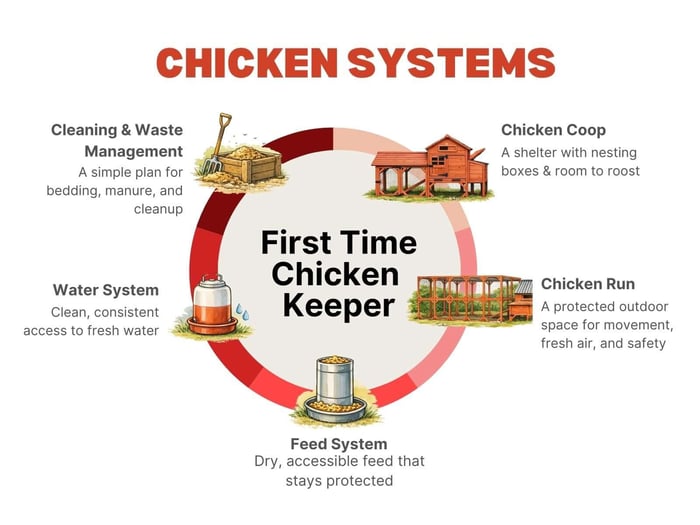
1. Coop
Shelter, roosting, and nesting with proper airflow
The coop is where your chickens rest, lay eggs, and stay protected from the elements. It should be sized for adult birds and designed to stay dry, secure, and comfortable year-round.
Proper airflow is essential here. A well-designed coop allows fresh air to move through without creating drafts at roosting level. This helps control moisture, odors, and overall air quality, especially during colder months when chickens spend more time inside.
When the coop is sized correctly and ventilated well, it becomes a stable foundation for the rest of your setup.
2. Run
Secure outdoor space with ventilation and weather management
The run is where chickens spend most of their waking hours when free-ranging isn’t possible. It provides space to move, scratch, and stay active while remaining protected from predators.
A good run is secure, thoughtfully enclosed, and designed to handle real weather conditions. Ventilation matters here too. Air movement helps keep the space drier, reduces odors, and makes the run usable in more seasons.
When the run is treated as a core part of the system rather than an add-on, daily routines feel safer and more consistent.
3. Feed System
Dry, accessible, pest-resistant feeding setup
A feed system is more than a container for food. It determines how often you refill, how much waste is created, and whether pests become an issue.
A good feed setup keeps food dry, limits spillage, and allows chickens easy access without creating extra mess. When feed is protected and organized, daily chores take less time and frustration stays low.
For a first time chicken owner, this is one of the simplest ways to make daily care smoother.
4. Water System
Consistent, clean access to water year-round
Water is one of the most important and most frequently managed parts of chicken keeping. Chickens need constant access to clean water in every season.
A solid water system stays clean, is easy to refill, and works in both hot and cold conditions. When water is easy to manage, you’re less likely to skip checks or deal with sudden problems.
Because water affects health, egg production, and overall flock well-being, it deserves its own place in the system.
5. Cleaning and Waste Management
Manure control and ease of maintenance
This part of the system is less about buying something new and more about planning ahead. Keeping the coop clean is essential for flock health, and waste management affects air quality, moisture, odor, and how often routine cleaning actually happens.
A simple setup starts with a clear way to collect manure, such as a poop tray or droppings board, and a bedding choice that fits your climate and routine. Just as important is knowing where waste will go once it leaves the coop. That might be a compost bin, a compost pile, or a designated space in your yard.
When there is a plan for waste, cleaning becomes part of the routine instead of a dreaded task. That keeps the coop cleaner, the flock healthier, and the entire system working as intended.
If you want to go deeper on managing manure and using it in your garden, we break it all down here: Chicken Poop 101: Manage Your Coop, Compost, and Garden Like a Pro.
How These Pieces Work Together
None of these components exist on their own. The coop, run, feed, water, and cleaning setup all influence each other.
When they’re planned together:
Chickens stay healthier
Daily care takes less time
Problems are easier to manage
The first year feels far more doable
That’s the difference between piecing things together and starting with a system.
Final Thought: Start With a Setup That Works Together
The first year matters more than most people realize. A thoughtful setup makes learning easier and mistakes less overwhelming. I learned the hard way that a setup built piece by piece creates more stress than it needs to.
When you start with a system that works together, daily care feels easier, problems feel smaller, and confidence builds naturally. You do not need to have everything figured out on day one. You just need a setup that supports learning as you go and fits into real life.
That is what turns chicken keeping into something you enjoy instead of something you constantly worry about. Besides, the less time you worry about your set-up, the more time you can spend hanging out with your new flock!
FAQs
What should a first time chicken owner focus on first?
A complete setup that includes proper space, airflow, protection, and easy cleaning should come before ordering chickens.
How many chickens should a first time chicken owner start with?
Most people start with three to six chickens, but the setup should always be sized for adult birds.
Do first time chicken owners need a run if they plan to free-range?
Yes. There will be days when free-ranging isn’t possible, and a secure run provides consistency and safety.
Can a first time chicken owner upgrade their system later?
Absolutely yes! A good system allows for upgrades and adjustments without replacing major components.
Is it normal to feel overwhelmed as a first time chicken owner?
Absolutely. Planning a complete setup ahead of time helps reduce that overwhelm significantly.